Why everyone is suddenly asking: what is Jev AI?
Ask a chatbot whether a customer complaint is urgent and you get a polite paragraph. Ask Jev and you get a number your software can act on, in a fraction of a second.
That difference is why Jev became one of the most talked-about AI launches of 2026. San Francisco lab TypeSafe AI released it on 15 September 2026, alongside a $40 million seed round led by DCVC. Nine days later, The Information reported that the company was in talks to raise $1 billion or more at a valuation near $10 billion (report summary); TypeSafe has not confirmed those talks.
Developers moved just as fast. Within 24 hours of arriving on Vercel's AI Gateway, Jev was in use by nearly 13% of paying teams, twice the share of OpenAI's GPT-5.6 family, making it the fastest-adopted model in the gateway's history.
Jev does something no mainstream AI model does: it refuses to write. No essays, no code, no chat. It only makes decisions, and that single design choice makes it dramatically faster and cheaper than the chatbots we know.
In this guide you will learn:
- What Jev is, who built it and why it is named after a 19th-century economist
- How Jev works, explained with one simple diagram
- Jev vs SLMs vs LLMs, side by side
- Whether Jev will replace LLMs (short answer: no, but it will change how they are used)
- Real use cases, including examples for Indian businesses
What is Jev AI? (Quick answer)
Jev is an AI model from TypeSafe AI that makes decisions instead of writing text. You give it some content plus a set of questions with fixed answer options. It returns the chosen answer for each question, with probabilities and a confidence score, usually in 70 to 500 milliseconds.
Think of Jev as a smart "if" statement for software. Messy, human-written text goes in; a clean, typed decision that code can branch on comes out. TypeSafe calls it the first System One model.
Jev at a glance
Sources: TypeSafe launch post, Maxim's technical breakdown.
Who built Jev?
TypeSafe AI was founded in 2024 by Diogo Almeida (CEO), Sasha Sheng (COO) and Erik Gafni (CTO), according to Dealroom. Almeida is a former OpenAI researcher and one of the co-inventors of RLHF, the training method that turned raw language models into ChatGPT. The team spent two years in stealth before launching Jev.
His pitch is simple: if AI models are so smart, why has so little real work been automated? His answer is that chat models were built to please people, not to plug reliably into software.
What is a "System One model"?
The name comes from Daniel Kahneman's book Thinking, Fast and Slow. System 1 is fast, intuitive judgment; System 2 is slow, deliberate reasoning. Today's AI race is mostly about System 2: longer chats, deeper reasoning, bigger agents.
But most AI work inside a business is System 1. Is this lead serious? Which team should handle this ticket? Is this review a complaint? TypeSafe expects large-scale automation to be roughly 99% machine-to-machine, where a human-friendly paragraph is pure overhead.
A System One model still understands natural language like an LLM. The difference is the answer: a typed value with calibrated probabilities, not prose.
Why is it called Jev?
Jev is named after William Stanley Jevons, the economist behind the Jevons paradox. When steam engines burned coal more efficiently, Britain ended up burning more coal, not less. TypeSafe is betting the same will happen to AI: every big drop in the cost of a decision unlocks many more uses for it.
Does Jev really "never hallucinate"?
Only in a narrow sense. Jev cannot return an answer outside the options you define, so made-up labels, broken JSON and invented citations are impossible. It can still pick the wrong option, sometimes with high confidence. As The Register pointed out, being correct and being well-formatted are not the same thing.
How does Jev work? One input, many questions, one pass
Jev answers all your questions in a single parallel pass, which is why it responds in milliseconds instead of seconds.
A normal LLM writes its answer one token at a time, and every new word needs another trip through the model. Jev skips writing entirely. It reads the input once, scores every question against it at the same time, and returns a handful of numbers.
Every Jev request has two parts:
- State: the content to judge, such as a customer message, a lead-form entry, an invoice or a JSON record.
- Questions: one or more typed questions, each with its own ID and a fixed set of possible answers.
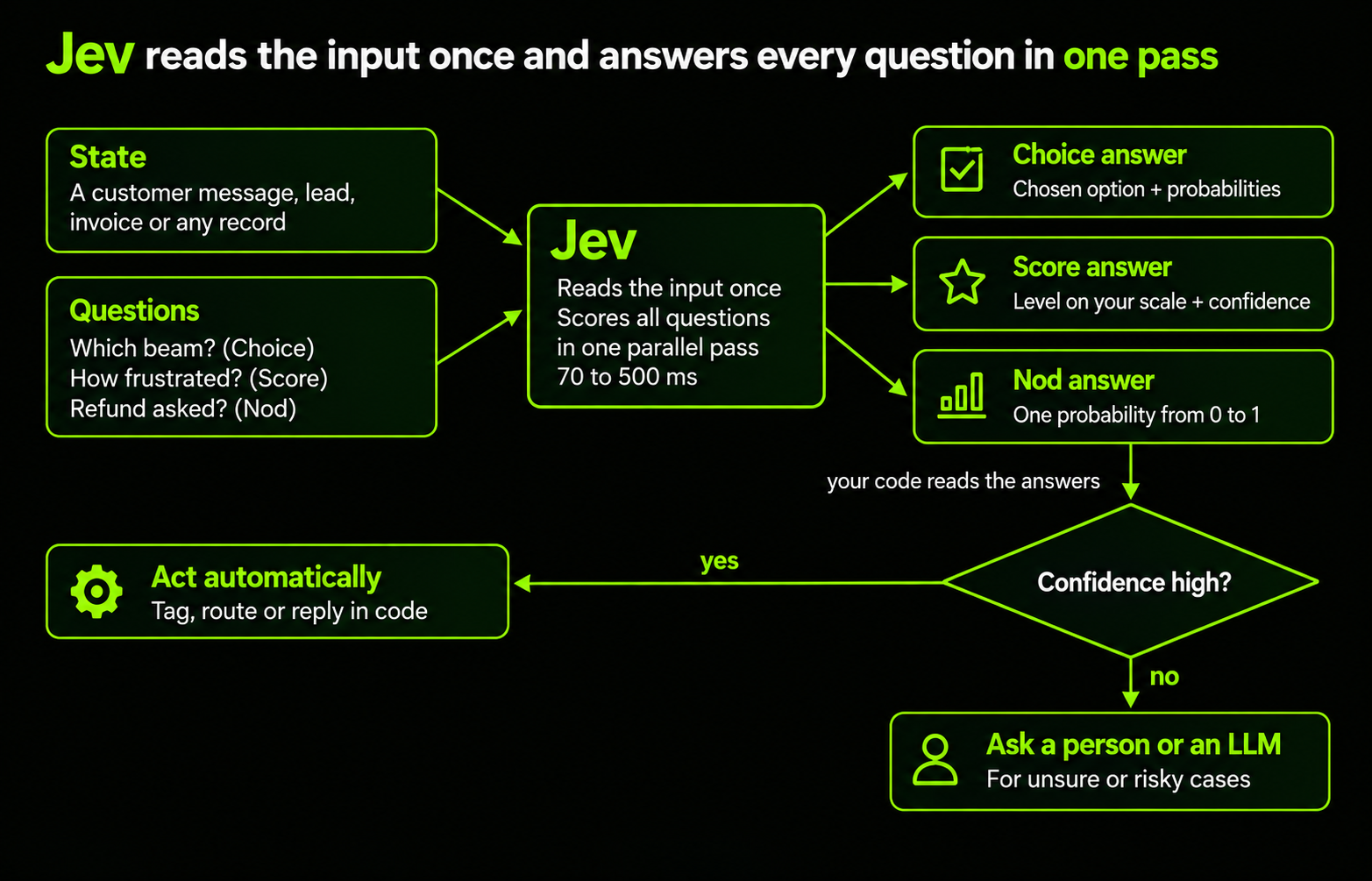
Every question sees the same input at the same time; your code then uses the confidence score to decide whether to act alone or escalate.
The three question types
Source: TypeSafe docs.
A worked example
Imagine an online gift store in Punjab receives this WhatsApp message: "Ordered a gift 6 days ago, still not delivered. I need it before Diwali, otherwise cancel and refund!"
One Jev call can ask three questions at once:
- Team (Choice): delivery, billing or product quality
- Frustration (Score): calm, annoyed or angry
- Refund requested? (Noul): true or false
The answers come back as numbers, for example delivery at 0.90, frustration at level 1 and refund requested at 0.95 (illustrative values). Your code can then tag the ticket, alert the delivery team and offer express shipping before a human reads it.
Confidence tells your code when to trust it
Every Choice and Score answer carries a confidence value from 0 to 1. That is what makes Jev safe to automate with: your code acts alone when confidence is high and hands the case to a person, or a bigger model, when it is low.
TypeSafe suggests setting the bar by risk. A read-only action, such as showing an order status, might go ahead at 0.5; an irreversible one, such as approving a refund, might need 0.9 or a human check. Treat these numbers as starting points to tune on your own data.
Why Jev is so fast and cheap
- No writing loop: the answer is a few numbers, so response time does not grow with answer length.
- Input is read once: adding questions barely changes response time, and each extra question costs only a few dozen tokens.
- Output is free: you pay only for input, at $0.042 per million tokens. Frontier LLMs charge $0.20 to $10 per million input tokens, with output around five times dearer; OpenAI's GPT-5.6 Terra, for example, charges $2 in and $12 out.
In TypeSafe's own side-by-side demo, Jev answered in 0.114 seconds where GPT-5.6 Terra took 8.566 seconds.
Jev vs SLMs vs LLMs: what is the difference?
The real difference is not size but output: LLMs and SLMs write text, while Jev returns decisions.
- LLM (large language model): a general-purpose text generator, such as OpenAI's GPT or Anthropic's Claude models. LLMs have tens of billions to trillions of parameters and shine at writing, reasoning, coding and conversation.
- SLM (small language model): the same transformer recipe at a much smaller size, typically from a few hundred million to about 10 billion parameters (guide). Examples include Microsoft's Phi, Google's Gemma and Mistral's smaller models. SLMs are cheaper and faster, are often fine-tuned for one domain, and can run on your own server or device.
- Jev (System One model): understands language like an LLM but never generates text. It returns typed answers with calibrated probabilities.
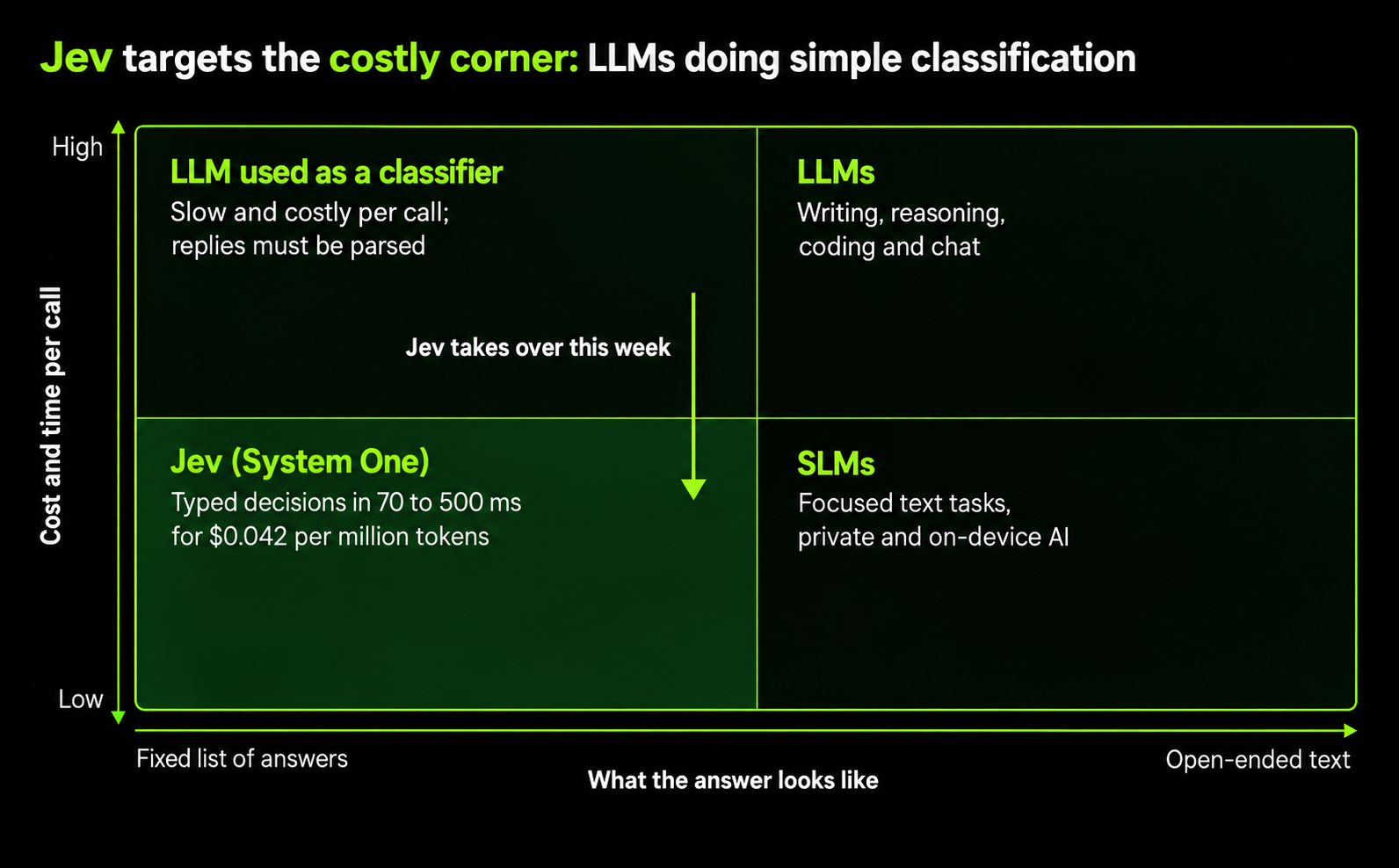
The shaded top-left corner, a big LLM answering simple fixed-choice questions, is where many teams overspend today and exactly where Jev is aimed.
Is Jev just a small language model?
No. An SLM is a smaller text generator: it still writes word by word and can still drift off-format. Jev changes the contract itself, with a closed answer space, parallel scoring and calibrated probabilities. TypeSafe positions it as a frontier model that matches LLM-level judgment on System One tasks while being about two orders of magnitude faster and cheaper (launch post).
Where SLMs and Jev agree
Both are part of the same shift away from "one giant model for everything". Gartner predicts that by 2027, organisations will use small, task-specific AI models at least three times more than general-purpose LLMs. NVIDIA researchers made a similar case in their paper Small Language Models are the Future of Agentic AI: agents mostly repeat narrow tasks, so most calls do not need a giant model.
Jev pushes that logic one step further. If you already know every possible answer, you do not need a model that writes at all.
Which one should you use?
- The answer will be read by a person, or it is open-ended: use an LLM (or an SLM if the task is narrow).
- The data cannot leave your servers, or you need offline AI: use an SLM.
- The answer comes from a known list and feeds your code: use Jev.
Is Jev going to replace LLMs?
No. Jev will replace the wrong use of LLMs, not LLMs themselves.
Today many companies pay a large, slow text generator to answer questions like "Is this spam?" and then write extra code to parse its reply. That is the job Jev is built to take over. Writing, reasoning and conversation stay with LLMs.
Four reasons Jev will not replace LLMs
- It cannot write. No emails, blog posts, code, summaries or explanations. Most of the AI people use every day, from ChatGPT-style assistants to coding agents, depends on generation.
- It has hard limits, by TypeSafe's own admission. Version 1.13 accepts text only, works best in English, struggles with counting, maths and comparing dates, loses accuracy on long, noisy inputs, and can be steered by adversarial text (failure modes summary).
- The headline numbers are the vendor's own. The "193.6x faster, 444.6x cheaper" claim comes from workflow tests designed by TypeSafe's team, scored against the average of GPT-6 Astra and Fable 5.1. TypeSafe itself calls these the high end and gives a typical range of 40x to 200x faster (launch post).
- It is a category of one. Jev is the only System One model so far, and nothing stops the large labs from building their own decision layer.
What Jev will change
- The AI stack becomes tiered. A cheap decision model handles narrow, high-volume judgments, and an LLM handles writing and reasoning. TypeSafe describes exactly this split, with Jev as a control layer and an LLM drafting the text.
- Many LLM calls disappear. When Jev can decide that a request is a simple order-status check, no expensive LLM call is needed at all.
- Uncertainty becomes a business rule. Escalation thresholds live in code, where they can be tested and audited, instead of being buried in a prompt.
- We will use more AI, not less. True to the Jevons paradox, checks that were too costly with LLMs become affordable: verifying every chatbot reply, scoring every lead, tagging every review.
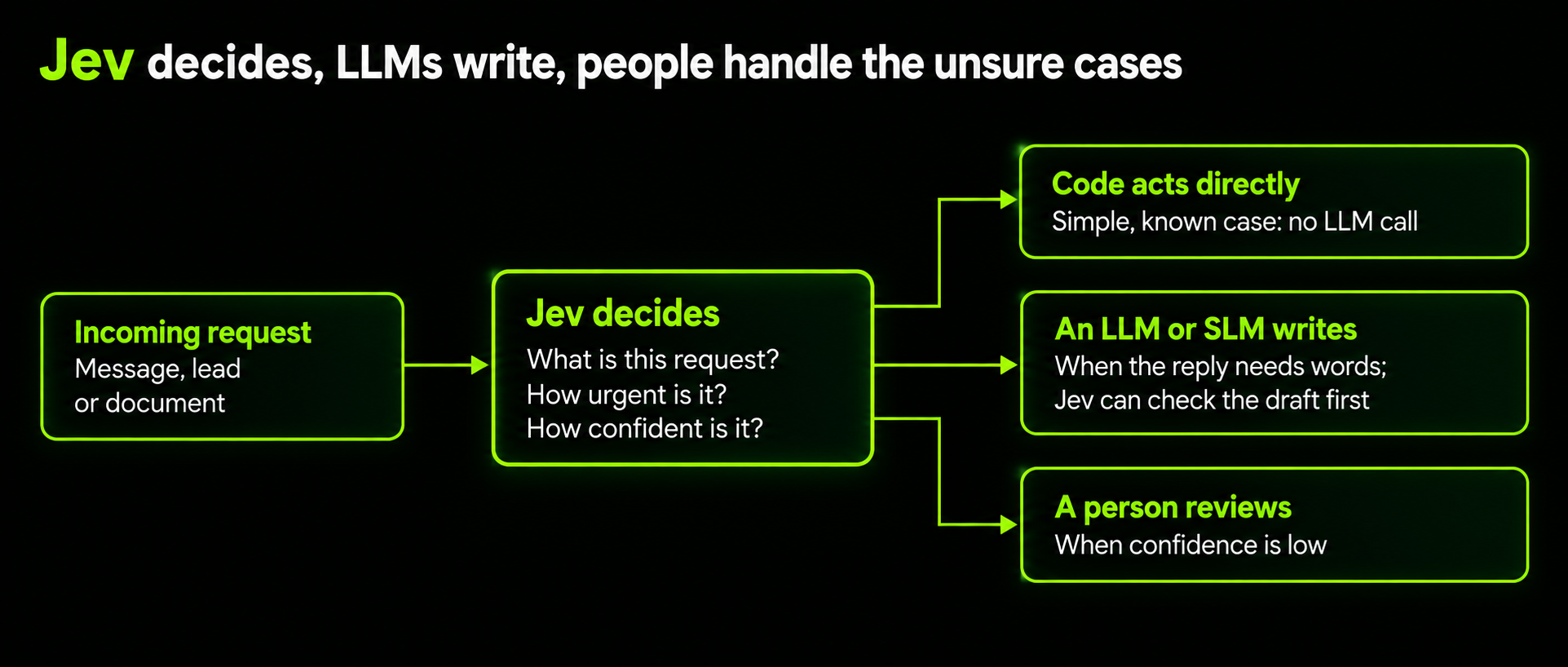
Many requests never reach an LLM at all, and the ones that do can be checked by Jev before a customer sees the reply.
The verdict: think of LLMs as your writers and thinkers, and Jev as a fast, tireless decision clerk. The smartest teams will hire both.
Top use cases of Jev AI
Jev fits any task that is high in volume, repeats the same judgment, and has answers you can list in advance. TypeSafe names its biggest opportunities as classifying service requests, evaluating invoices, triaging security alerts and reviewing the work of AI agents (SiliconANGLE).
The Indian-business examples are illustrations of where the pattern fits, not published deployments.
The golden rule: ask small questions
Jev works best when one big judgment is broken into several narrow ones. Instead of asking "Is this a good lead?", ask separately about budget, timeline and intent, then combine the scores with weights in your own code. You can change the weights any time without re-running the model, and every individual score stays available for audit.
When not to use Jev
- Writing anything: ad copy, blog posts, emails, product descriptions or code
- Open-ended chat, advice or explanations
- Arithmetic, counting or comparing dates (do these in code)
- Images, audio or video (text input only, for now)
- Questions whose possible answers you cannot list in advance
What Jev means for your business, and how to start
Jev makes an AI decision cheap enough to run on every lead, ticket and review. The question shifts from "Can we afford AI here?" to "Which decisions should we automate first?"
- List your repeated decisions. Where does your team read text and pick from a fixed set of options? Lead quality, enquiry routing, review tagging and document checks are common starting points.
- Break each one into small questions. One question per factor, with clear answer options and an "other" option for anything unexpected.
- Test on data you already have. Run Jev on past leads or tickets where you know the right answer, and measure accuracy before going live.
- Set confidence thresholds by risk. Let the model act alone on low-risk steps; send low-confidence or irreversible cases to a person.
- Keep LLMs for the words. Use Jev to decide and an LLM to draft the replies, ads and summaries that need language.
Two notes for Indian businesses. First, Jev works best in English, so if your customers write in Hindi, Punjabi or Hinglish, test those messages separately before trusting the results. Second, Jev is a cloud API, so check your obligations under India's Digital Personal Data Protection Act before sending customer data to it.
To try it, developers can request early access at typesafe.ai, or call it today through Vercel's AI Gateway using the model ID typesafe-ai/jev.
Want AI that actually works inside your business?
At Om Softwares, we build fast websites, lead funnels and performance marketing campaigns for businesses in Punjab, Himachal Pradesh and abroad. If you want enquiries routed, leads qualified or reviews tagged automatically, talk to our team and we will help you pick the decisions worth automating first.
Frequently asked questions about Jev AI
What is Jev AI in simple words?
Jev is an AI model that makes decisions instead of writing text. You send it content and questions with fixed answer options, and it returns the best answer for each, with probabilities and a confidence score, in 70 to 500 milliseconds.
Who created Jev?
Jev was created by TypeSafe AI, a San Francisco lab founded in 2024 by Diogo Almeida, Sasha Sheng and Erik Gafni. Almeida is a former OpenAI researcher and a co-inventor of RLHF. Jev launched on 15 September 2026 with a $40 million seed round led by DCVC.
Is Jev an LLM?
No. Jev understands natural language like an LLM, but it never generates text. It belongs to a new category TypeSafe calls System One models, which return typed decisions with calibrated probabilities instead of sentences.
Will Jev replace ChatGPT and other LLMs?
No. Jev cannot write, chat, code or explain, so it cannot replace LLMs. It is likely to replace the expensive habit of using LLMs for simple classification and routing, leaving LLMs to handle writing and reasoning.
What is the difference between Jev, SLMs and LLMs?
LLMs are large, general text generators. SLMs are smaller, cheaper text generators, usually tuned for one domain. Jev generates no text at all: it scores every question in one parallel pass and returns answers from a list you define.
How much does Jev cost?
Jev costs $0.042 per million input tokens, which is under ₹5, and output tokens are free. In TypeSafe's own demo, one task cost $0.000081 on Jev against $0.013880 on a frontier LLM.
Can Jev hallucinate?
Jev cannot invent answers outside the options you define, so broken JSON, made-up labels and fake citations are impossible. It can still choose the wrong option, sometimes confidently, so important actions should use confidence thresholds and human review.
Does Jev work in Hindi or Punjabi?
Jev is text-only and performs best in English. It may handle other languages, but TypeSafe has not published accuracy figures for Hindi, Punjabi or Hinglish, so test your own messages before relying on it.
How can I try Jev?
Developers can request early access at typesafe.ai and call Jev through TypeSafe's SDKs or HTTP API with the model name jev-latest. It is also available through Vercel's AI Gateway under the model ID typesafe-ai/jev.
References
From TypeSafe AI
- Introducing System One Models & Jev, TypeSafe AI blog, 15 September 2026
- System One, TypeSafe documentation
- AI primer, TypeSafe documentation
Analysis and news coverage
- What Is Jev? Inside TypeSafe AI's System One Model, Swapnoneel Saha, Maxim AI, 21 September 2026
- TypeSafe AI debuts model for machines that plays Doom, Thomas Claburn, The Register, 16 September 2026
- TypeSafe AI exits stealth with $40M to build AI for use by software, Paul Gillin, SiliconANGLE, 16 September 2026
- Jev is the fastest-adopted model in AI Gateway history, Vercel, 18 September 2026
- TypeSafe AI, creadores de Jev, negocian ronda de US$1.000M, El Ecosistema Startup, 25 September 2026 (in Spanish)
- TypeSafe AI | Jev company profile, Dealroom
Small language models
- Gartner predicts small, task-specific AI models will be used three times more than LLMs by 2027, Gartner, 9 April 2025
- Small Language Models are the Future of Agentic AI, Belcak et al., NVIDIA Research, arXiv 2506.02153
- LLM vs SLM: What They Are, How They Work, and When to Use Each, Deepak Gupta, updated 18 August 2026